About Aleksis Kallio
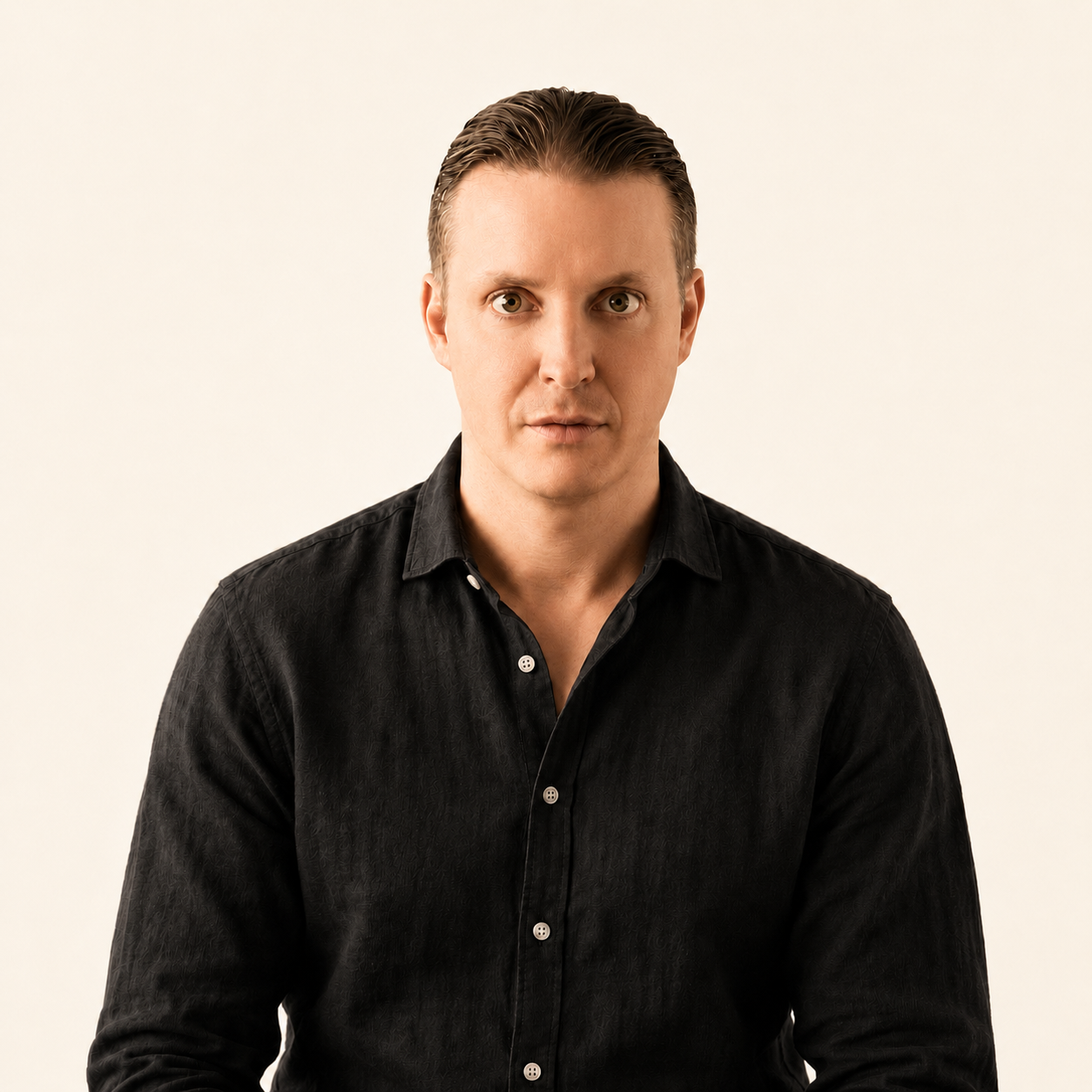
Aleksis Kallio learned the central truth of his work as a CEO making payroll on three hours of sleep.
For eight years he ran a yoga business he had built from a single studio into a nine-city franchise. He had personally trained more than three hundred instructors. He understood breath, body, and the autonomic nervous system at a level very few operators in the corporate world ever encounter, because he had been teaching it daily, in person, for years. And he was the one running the company. He had the books to read, the staff to hire, the leases to negotiate, the regulators to manage, the partners to align, the cash flow to forecast. He had everything a CEO has. And he had the same body breaking down in the same way every operator's body breaks down: chronic sympathetic activation, sleep that fragmented at three in the morning, a baseline anxiety the practices on his own studio walls were supposed to be able to fix.
What he learned during those years — and what he could not have learned any other way — is that the biggest threat to executive performance is not strategy, competition, or time. It is a nervous system that has been running at threat-detection level for years and no longer knows how to come down.
He learned, in his own body and then in the bodies of the executives he began to work with privately, that mindset is not the lever. The lever is physiology — breath, CO2 tolerance, basal temperature, autonomic tone, sleep architecture, light, movement — and a daily ritual architecture that holds it in place. Without that lever, no amount of journaling, coaching, or strategic clarity will hold. With that lever, even very heavy executive loads become sustainable for decades.
He closed the yoga business to work one-to-one with senior operators in this specific problem. He runs the practice under his own name.
His method is body-first and measurable. Every client is taught the same handful of physiological metrics — control pause (BOLT), morning body temperature, heart-rate variability — and a tested sequence of breath and recovery protocols that move those metrics. Within weeks the client can see, in their own data, that something is changing. Within months, restorative sleep returns, the three-a.m. wake-ups end, and the inner room of decision-making becomes noticeably quieter.
On that foundation he installs a frame. The deeper question — what is this work for, what is the shape of a life worth running this hard, what part of my current identity is paying the bill in my physiology? — is one the ancient contemplative traditions, particularly the Indian yogic lineage, treated with extraordinary sophistication for thousands of years before any of our current performance literature existed. Aleksis reads those texts in their primary form and uses their instruments inside the engagement. He uses them as instruments — not as belief systems. The client does not have to adopt a worldview. They have to live inside a clearer frame for what they are doing and why, because without that, the regulation they have built will eventually be eroded by an unexamined life.
The result of nine months of this work is not relaxation. It is regulation. From regulation comes clarity, restored judgment, sustained energy, and the capacity to lead at the level the client is capable of — without the body sending the bill ten years later.
Aleksis Kallio lives and works in Porvoo, Finland. He takes a small number of one-to-one clients each year.
On the bookshelf
Patrick McKeown on breath. James Nestor's Breath. Stephen Porges on polyvagal theory. Bessel van der Kolk's The Body Keeps the Score. Robert Sapolsky on stress physiology. Matthew Walker on sleep. Marcus Aurelius's Meditations. The Bhagavad Gītā. Patañjali's Yoga Sūtras. The Pratyabhijñā-hṛdayam.
Updated periodically.